Popular Culture & History
Cannonballs and Curtain Calls
The Wildest Acts of Vaudeville, Circus and Music Halls
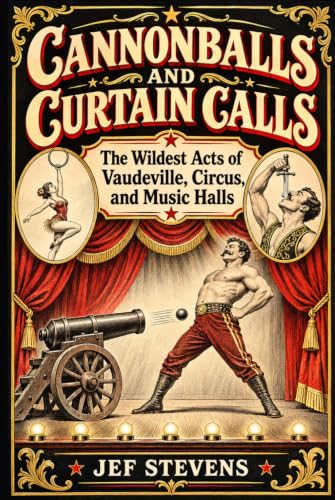
Writing the book
After writing about Le Pétomane, a man who turned farting into a successful stage career, I wanted to know who else might have shared the bill. Show business had accommodated him. There were bound to be some interesting neighbors.
Researching Cannonballs and Curtain Calls introduced me to people whose working equipment included cannons, swords, motorcycles, crocodiles, and a remarkably patient lion. The details of their lives kept pulling me further into their stories. Ethel Purtle’s lion grew old and retired; she carried on running the business. Sword swallower Edith Clifford bought herself a circus. These were people with some unusual things to put on an expense account.
One detail that particularly stayed with me was Leona Dare’s surviving mouthpiece, preserved in a case lined with red satin and velvet. This small piece of equipment had helped support her high above an audience. Reading about it brought the whole performance into focus: the preparation, the strength, and the confidence required to leave the ground.
I enjoyed finding those connections between the astonishing act and the person who packed it up afterward. There is plenty to laugh about in this book, along with nerve, ingenuity, affection, and occasional heartbreak. I wanted readers to finish each chapter feeling they had met someone worth remembering—and wondering who could possibly follow them.
About the book
Applause was the easy part.
Frank Richards took a cannonball to the stomach. Zazel became the projectile. Ethel Purtle drove with a lion in the passenger seat. Joseph Pujol dressed for a recital whose music came from a thoroughly unexpected direction.
Cannonballs and Curtain Calls brings together twenty-six lively, illustrated profiles of sword swallowers, aerialists, strongwomen, jugglers, motorcycle riders, and masters of peculiar bodily talents. Their careers crossed vaudeville stages, circus rings, music halls, and traveling fairgrounds.
Behind the extraordinary performances were people with partners, families, ambitions, and bills to pay. Edith Clifford bought a circus. Lillian LaFrance owned the wooden wall she rode. Mauricia de Tiers followed her airborne automobile act with a career as a mayor. Their stories reveal the skill, ingenuity, and business sense that kept audiences coming through the door.
Historical photographs and period posters appear alongside original illustrations, while dry humor and revealing human details bring these remarkable entertainers into focus. Fame might last a season; a good act could support a household.
For readers who enjoy offbeat history, forgotten lives, and true stories that sound invented, here is a show worth taking a seat for.
From the author
I spent some time performing magic, and I’ve always been curious about the work that goes into a few minutes onstage. For this book I wanted to find out how variety performers built a living around those few minutes.
Book excerpt
Miss La La
The Woman in Degas’s Rafters
In January 1879, Edgar Degas went to the Cirque Fernando in Paris and watched a twenty-year-old woman rise toward the roof by her teeth. She hung from a rope attached to a leather mouthpiece. He sketched her, then painted her. By April, Degas’s painting of Miss La La was on view at the Fourth Impressionist Exhibition.
Her name was Anna Albertine Olga Brown. Born in Prussia in 1858, the daughter of a European mother and an African American father, she had been using the professional name Miss La La since early 1877.
From Cannonballs and Curtain Calls, page 17.